Process plants and hazardous areas
In a process plant, the hazardous-area classification decides which radios you may install and where, so the wireless design starts from the classification drawings, not from the coverage map.

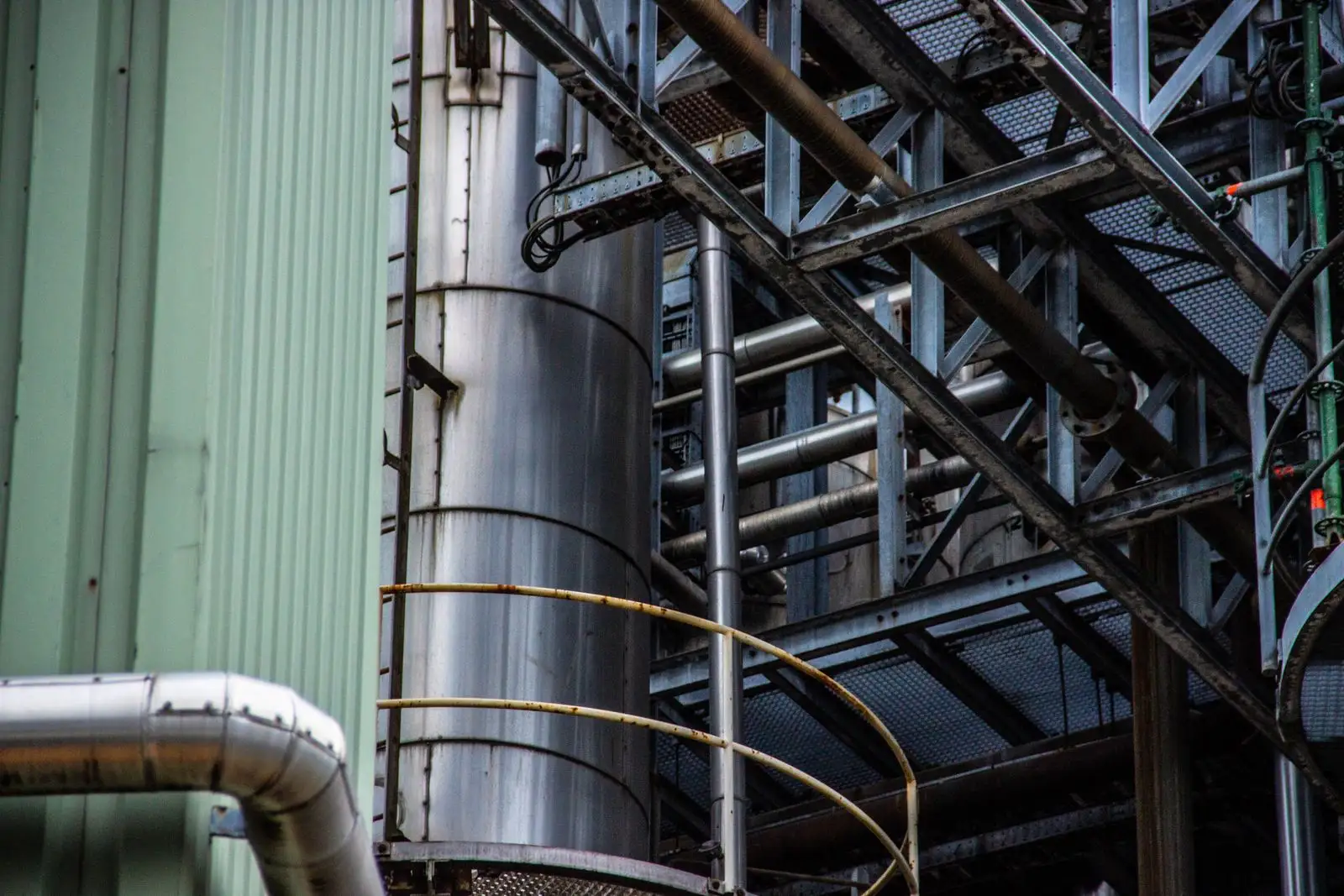
In a process plant, the first constraint on your wireless design is not RF. It is the area classification, which decides what hardware may be installed where.
Refineries, chemical plants and pharmaceutical sites all have areas where a flammable gas, vapor or dust can be present. Electrical equipment in those areas falls under hazardous-location rules, and an access point is electrical equipment.
What runs there
A process plant moves liquids and gases through heating, cooling, compression and extraction, and controls temperature, pressure, flow and level. Radio has served for years to monitor and control processes where cabling is too costly or impractical.
Sensor networks that are not Wi-Fi. Two standards built for wireless field instruments are WirelessHART (IEC 625911) and ISA100 Wireless (IEC 627342). Both use IEEE 802.15.4 radios with a nominal 5 MHz of bandwidth. WirelessHART is a mesh: each device can route messages for its neighbors, and a network manager schedules traffic and routes. A survey of WirelessHART research lists 15 channels for WirelessHART and 16 for ISA100.11a, all in 2.4 GHz, both hopping3. The ISA100 industry body lists uses from well-head and tank level monitoring to leak detection, gas detection and open loop control, and states that ISA100 supports a wide range of applications, including safety. That is the body’s own claim.
People and their devices. NIST gives wireless networking for mobile workers as an example of unlicensed industrial radio, beside sensor networks. In a 2.4 GHz capture in NIST’s guide, Wi-Fi channels carry file transfer, video and voice while sensor instruments hop across the same band.
Steel, indoors and out. A process site mixes open-air units and buildings. NIST uses a tank farm to show the obstructions you keep out of a link’s path. Its propagation study measured a steam plant about 50 m by 80 m, with boilers, overhead piping, and large pipes and conduits that could act as waveguides and reflectors4.
What it needs from the network
What a process application needs depends on its class, and the classes span two orders of magnitude.
The WirelessHART survey sorts process applications into classes: safety and emergency functions at 10 ms, closed-loop control at 10 to 100 ms, and monitoring and open-loop control at up to 1,000 ms. It notes the industrial wireless standards were developed mainly for the monitoring end of that range, such as open-loop control and alerting. Whether any safety or emergency function rides on wireless is a decision for the plant’s safety engineering, made before your design starts.
Mesh buys resilience with time. NIST notes a mesh routes around failed nodes at the expense of deterministic delay, while a star fixes its hop pattern before deployment.
Recovery matters as much as uptime. After a power loss, NIST warns, some systems reconnect a device in seconds and others take minutes per device, which can add up to hours when a gateway or router loses power.
Mobile workers need coverage along the routes they walk. Their video and file transfers on 2.4 GHz share airtime with the sensor networks.
Field note. You have to know everything on the air so control and safety traffic are prioritized over large transfers and updates.
How wireless fails there
The access point cannot go where the RF wants it. Under OSHA, equipment in a hazardous (classified) location must be intrinsically safe, approved for the location, or safe for it. Class I areas, those with flammable gases or vapors, are classified by Divisions or by Zones. Zone 0 has ignitable concentrations present continuously or for long periods, and Division 1 can have them under normal operating conditions. Approved equipment must be approved for the specific gas group as well as the class, and marked with class, group and temperature. A marking such as Class I, Zone 0, AEx ia IIC T65 says exactly where a device may go.
Europe regulates the same equipment under the ATEX directive, which requires conformity assessment before equipment for explosive atmospheres is placed on the EU market. Internationally, the IECEx system keeps one database of certified Ex equipment, with certificates issued by approved certification bodies rather than by IECEx itself.
NIST states the consequence for wireless plainly: with approvals such as intrinsic safety ratings considered for every node, a set of acceptable nodes can only be used at certain locations. Your access point goes where an approved product can be mounted. Coverage gaps follow from that, not from the channel plan.
A crowded 2.4 GHz band. WirelessHART and ISA100 live only in 2.4 GHz. NIST’s capture shows Wi-Fi and hopping sensor networks in that band may interfere with each other. The sensor networks defend themselves by rejecting and blacklisting channels with high packet loss. Every channel they give up to your Wi-Fi is one fewer channel to hop across.
Pipes, vessels and racks. NIST describes refineries as harsh because of the density of highly reflective materials, and its steam plant runs with the transmitter above the piping show how harsh the environment can be if propagation is ignored. The usual objection is that OFDM handles multipath. It handles echoes. It does not handle a vessel between a worker and the only access point you were allowed to mount. When a large object blocks the direct path, the link may be lost.
Cold, outdoors and offshore. Outdoor units add their own limits. Flameproof equipment may not be suitable below −20 °C unless it is approved for lower temperatures. In 6 GHz, low-power indoor access points are limited to indoor locations, and standard power, low-power indoor, geofenced variable power and very low power 6 GHz devices are all prohibited on oil platforms6.
Design implications
Start from the classification drawings. OSHA requires classified areas to be documented, with the documentation available to those who design and install equipment there. Get it before the first survey. Under the zone system, classification and equipment selection sit under the supervision of a qualified registered professional engineer. The wireless design fits inside those decisions. It does not make them.
Count the approved mounting points before you count access points. An access point outside the classified boundary is an ordinary product. One inside has to meet the hazardous-location rules for that class, group and temperature. Where approvals limit placement, plan for the gaps. NIST recommends path redundancy where RF conditions change, and two approved paths beat one ideal path you cannot build.
Leave 2.4 GHz to the sensors where you can. Put Wi-Fi clients on 5 GHz when they support it. Treat any Wi-Fi left on 2.4 GHz as a neighbor of the sensor networks, and record both in the spectrum management plan NIST recommends, with an inventory of every known network and emitter.
Check the 6 GHz device class for each part of the site. Indoor buildings, outdoor units and offshore structures get three different answers. Outdoors, standard power needs an automated frequency coordination (AFC) system and works only in 5.925 to 6.425 and 6.525 to 6.875 GHz. A standard power access point that cannot reach its AFC system must cease operation at 11:59 p.m. the following day, so the AFC path belongs in your availability design.
Power the backbone for recovery. Gateways and access points that drop with a power blip can take the mesh with them. NIST suggests batteries as backup to wired power for mission-critical applications.
How to validate
Survey everything on the air, not only Wi-Fi. Capture 2.4 GHz with the sensor networks running, and compare their packet loss with Wi-Fi load over a full shift.
Validate on the approved hardware at the approved mounting points. A survey with a test access point where the certified one cannot go measures a network you will never have.
Walk the routes people walk. Cover the units, pipe racks, tank farms and control buildings with the handhelds workers actually carry, indoors and out.
Test recovery, not only coverage. In a planned window, power-cycle a gateway and time how long the mesh takes to rebuild. NIST’s warning is hours, so measure your own.
In a hazardous area, the certificate on the enclosure draws the coverage map before the RF does.
About this page
Built from 11 sources: 3 standards bodies and labs, 4 regulators and government sources, 3 protocol owners and alliances and 1 research paper or thesis. Researched and drafted with AI assistance, then reviewed and approved by Ben Rutter on . How pages are made
- First published
- Last updated
Change history (1)
- First published
Cite this page
Plain
Ben Rutter. "Process plants and hazardous areas." OT Wireless, published October 5, 2026. https://otwireless.com/environments/process-and-hazardous-areas/
APA 7
Rutter, B. (2026, October 5). Process plants and hazardous areas. OT Wireless. https://otwireless.com/environments/process-and-hazardous-areas/
BibTeX
@misc{rutter2026processandhazardousareas,
  author = {Rutter, Ben},
  title = {{Process plants and hazardous areas}},
  year = {2026},
  howpublished = {\url{https://otwireless.com/environments/process-and-hazardous-areas/}},
  organization = {OT Wireless},
}