Automated warehouse
In an automated warehouse the RF changes with every pallet, the fleets keep getting denser, and a vehicle that drops inside an enclosed structure costs a shutdown, not a retry.

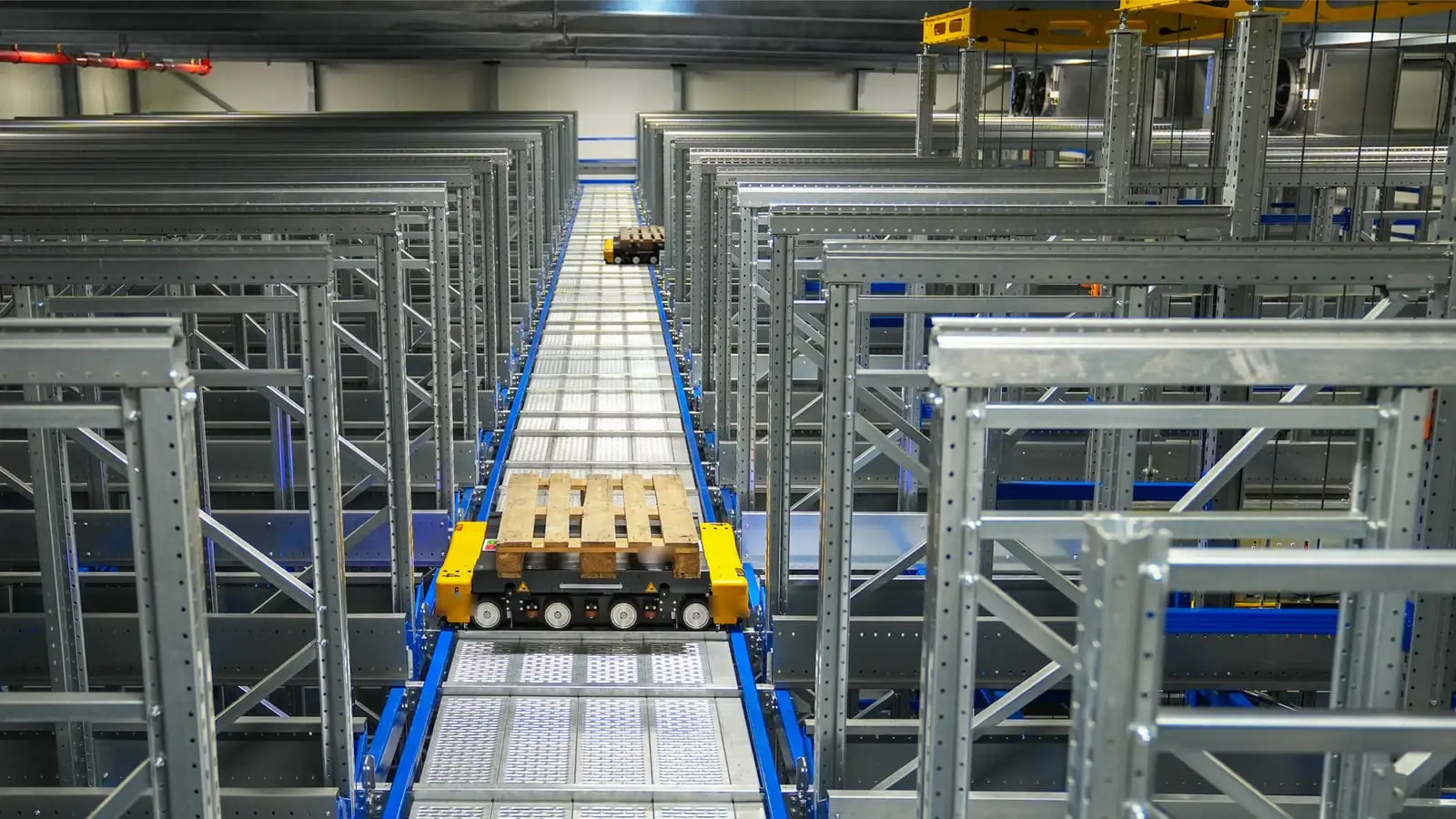

An automated warehouse is a steel building whose radio environment changes every time stock moves. The vehicles that move the stock depend on that environment, and there are more of them every year.
What a dropped link costs depends on where the vehicle is when it drops. In an open aisle it is a pause. Inside an enclosed storage structure it can be a shutdown and a person sent in to fetch the vehicle.
What runs there
Shuttles in the racking. In high-bay automated storage and retrieval systems (AS/RS), shuttles run on rails through the racking. A mesh vendor’s case study describes shuttles that carry radios and talk to a central traffic control system, in an environment of dense racking, shuttle rails and constantly moving goods. That is a vendor’s description, and a fair picture of the problem. Not every shuttle system puts control on open air. One supplier sells a slotted waveguide that carries data inside a shielded aluminum profile, for automated shuttle systems and stacker cranes, the aisle machines that store and retrieve loads,, and lists it as compatible with PROFINET and PROFIsafe. Ask the system builder which medium carries control before you plan Wi-Fi around it.
Mobile robot fleets. Picking robots retrieve items from storage positions and carry them to a packing station or container. Autonomous mobile robots (AMRs, vehicles that plan their own paths) and automated guided vehicles (AGVs) are driverless industrial trucks, the class of machine that ISO 3691-4 covers as a type C safety standard. The vehicles are controlled by a central system over the wireless network, the fleet manager.
Steel everywhere. Racking, rails and the vehicles themselves are metal. NIST describes how two rows of machines create a canyon effect that makes connectivity unreliable for a device inside it. A rack aisle has the same shape. NIST’s propagation study also found that industrial sites lose signal faster with distance than open space.
Stock that moves. Racks fill and empty as stock comes and goes. One wireless integrator states that liquids absorb, metal products reflect, dense packaging weakens coverage, and high pallet stacks block signal paths. It publishes no measurements for any of those effects. Treat them as directions to test, not as dB values.
What it needs from the network
Few interruptions, not only short ones. 5G-ACIA, an industry alliance for industrial 5G, defines survival time as the time an application can continue without an anticipated message. It also counts the cost after the message comes back. A robot may have to move to a safe restart position, which can take several minutes, so many short outages hurt application availability more than one long one. Network availability counts minutes offline. Fleet availability counts recoveries.
Coverage where recovery is expensive.
Field note. An autonomous bot disconnecting inside a safety-enclosed structure forces a temporary shutdown and a manual retrieval. Getting one stranded bot out by hand can take more than half an hour, and its cell, level, or aisle has to be locked out first. Depending on the structure, that can mean full PPE, crawling, and reaching into tight spots. When several bots drop together, it becomes hours.
What a vehicle does on loss of communication inside an enclosure is a safety decision, not a network setting. ISO 3691-4 starts from a risk assessment under ISO 121001 and classifies the areas driverless trucks work in, including restricted, hazard and confined zones, with requirements such as truck speed set per zone. The machine builder decides what happens when the link drops. The network decides how often it drops.
Airtime for control first. Control messages share the air with logs, diagnostics and map or software updates. The shuttle case study names safety-critical control data competing with logging and diagnostics as one of its four problems.
How wireless fails there
Aisles and shadows. When a large object blocks the direct path, NIST notes that the link may be lost. Serving the client from another access point is one answer, but hand-off from one access point to the other can be too slow.
Coverage that drifts with inventory. A survey taken with half-empty racks describes a building you will not have at peak season. NIST warns that frequent layout changes make installations prone to quality of service fluctuations, and its monitoring guidance covers the physical environment that affects propagation, alongside the spectrum and the network.
Roams in motion. Vendors quote handover times, and none of the figures is a measurement you can reuse. One mesh vendor states that a conventional Wi-Fi handover takes from a few hundred milliseconds to several seconds, without citing a test. The peer-reviewed field data comes from a car plant, not a warehouse: 85.84% of AGV disconnections of 3 seconds or more began with a roam attempt, and 57.53% came after a roam that succeeded2. Your fleet roams through its own client radios, so measure them.
Density.
Field note. Bot and AGV density is rising across industries and is saturating channels. 6 GHz is being deployed to relieve utilization.
Channel width makes density worse when it is chosen for peak speed. In simulations of dense WLANs, always taking the widest available channel maximizes a network’s own throughput but often starves its neighbors. In a warehouse, the starved neighbor can be your own fleet on the next access point.
Design implications
Design for the full building. Plan coverage for racks at their fullest and for the densest stock you expect to store, not for the day of the survey. Where RF conditions change, NIST recommends path redundancy over a single path you hope stays clear.
Treat enclosures as their own coverage zones. Any structure where a disconnect forces a shutdown and a manual retrieval deserves its own survey, its own coverage design and its own monitoring.
Spend 6 GHz on channels, not width. The U.S. 6 GHz band adds 1,200 MHz3, enough for seven 160 MHz channels or three 320 MHz channels4. A dense fleet gains more from many narrow channels than from a few wide ones. Low-power indoor rules keep those access points indoors, with client power 6 dB below the access point. Yards and docks outdoors need standard-power operation under an automated frequency coordination system, and only in parts of the band. None of it helps a vehicle whose radio cannot use 6 GHz.
Separate control from bulk. Schedule map pushes, log uploads and firmware downloads, and mark them below control traffic. NIST’s spectrum management plan keeps an inventory of every known wireless network and emitter. Extend it to an inventory of traffic.
How to validate
Survey at peak, then again. Survey with the racks full, and survey again whenever the stock profile or the layout changes.
Field note. The most common physical change behind a new disconnect pattern is aisles filling with product after the survey was taken. Large objects and vehicles passing in front of an access point leave a temporary dead zone on the far side of it.
Validate from the vehicle, on its real paths. Run vehicles through every aisle, lift and enclosure they serve, at production speed, and log every gap and its duration. Compare the longest gap with the loss-of-communication timeout the vehicle supplier publishes.
Measure utilization with the whole fleet running. Channel utilization on a quiet shift says nothing about the peak.
Count events per vehicle per shift. Each recovery costs time, so the number of interruptions matters as much as their total duration.
Keep watching. NIST recommends continual spectrum monitoring during operation, because the building you surveyed is not the building you run.
A survey is a photograph of a warehouse. The fleet’s disconnect log is the film.
About this page
Built from 12 sources: 2 standards bodies and labs, 2 regulators and government sources, 1 protocol owner or alliance, 2 research papers and theses, 4 vendor documents and 1 other source. Researched and drafted with AI assistance, then reviewed and approved by Ben Rutter on . How pages are made
- First published
- Last updated
Change history (1)
- First published
Cite this page
Plain
Ben Rutter. "Automated warehouse." OT Wireless, published October 5, 2026. https://otwireless.com/environments/automated-warehouse/
APA 7
Rutter, B. (2026, October 5). Automated warehouse. OT Wireless. https://otwireless.com/environments/automated-warehouse/
BibTeX
@misc{rutter2026automatedwarehouse,
  author = {Rutter, Ben},
  title = {{Automated warehouse}},
  year = {2026},
  howpublished = {\url{https://otwireless.com/environments/automated-warehouse/}},
  organization = {OT Wireless},
}